
Dislocated Lens Diagnosis and Treatment in Sarasota, FL
Sudden blurry vision after cataract surgery can be a sign that your lens implant has shifted
A dislocated intraocular lens can cause sudden, painless blurring of vision in one eye. This complication is becoming more common as cataract surgery happens earlier in life. Our retina specialists evaluate dislocated lenses with advanced imaging and provide effective surgical solutions to restore clarity and comfort.
If you are concerned your lens implant has moved out of place, a prompt dilated eye examination is the best way to protect your vision.
Dislocated Lens Symptoms and Diagnosis
Sudden vision loss after cataract surgery may indicate that the lens implant has fallen out of position. Having a cataract lens implant dislocate is an increasingly common occurrence, especially as patients receive cataract surgery at younger ages. If you live in Sarasota or Manatee county and are concerned that your lens implant has shifted, call today for a dilated eye examination with the dislocated lens specialists at Shane Retina.
The Lens Anatomy of The Eye
The lens is an M&M-shaped structure located near the front of the eye. It is held in place by tiny, hair-like cables called zonules. The zonules run around the entire circumference of the lens, connecting it to muscles in the eye wall. When the muscles contract, the lens changes shape, allowing the eye to focus on multiple distances.
In youth, the lens is soft and clear. As time goes by, the lens gets harder and yellower. Eventually, light has a difficult time passing through the lens, forming a cataract. When the cataract starts to interfere with daily visual activities, it is time for surgical cataract removal and replacement with an artificial lens implant.
What Happens During Cataract Surgery?
During cataract surgery, a circular opening is made in the thin bag that holds the lens called the capsule. Next, the surgeon removes the hardened, yellow cataract, careful to maintain the integrity of the capsule behind the lens. After the cataract is removed, a clear, artificial lens implant is injected into the capsule. Ideally, the lens will stay centered just behind the pupil for the rest of the patient’s life.
In some cases, a problem with the capsular bag or lens implant occurs at the time of surgery. If the bag becomes detached from the wall of the eye or the lens falls into the back of the eye, a second surgery may be required to fixate a new lens to the eyewall.
How Does A Lens Dislocate?
There are two mechanisms for a lens implant to dislocate into the back of the eye. The first occurs where a break in the capsular bag that holds the lens causes the lens to slip back. The second cause happens if the cables that attach the lens to the eye wall break, allowing the entire lens-bag complex to fall into the back.
What Are the Risk Factors for A Shifted Intraocular Lens?
There are two main categories of dislocated lens implant. The first occurs during your initial cataract surgery and is caused by a break in the layer that holds the lens or the cables that attach it to the eye. Anything that weakens the lens capsule, or its cables may cause a dislocation during surgery. This includes history of previous eye surgery, trauma, or use of prostate medication. Some patients have a condition called pseudo exfoliation, which weakens the cables (zonules) that connect the lens to the eye wall.
The second mechanism for lens dislocation is the gradual breakage over time of the cables that attach the lens implant to the eye wall. Eventually, enough cables break to allow the lens to shift away from the center of the pupil. This happens more often in patients with a history of trauma, multiple eye surgeries (especially retinal detachment repair), pseudo exfoliation, and complicated original cataract surgeries.
What Are the Symptoms of a Dislocated Lens?
The most common symptom of a dislocated intraocular lens implant is sudden, painless blurring of vision in one eye. The vision tends to be very blurry, but not blacked-out. Sometimes, the lens implant can be seen resting on the surface of the retina when laying on the back. If the lens is only slightly out of position, the patient may only notice a ghost or double image at nighttime as some light passes through the pupil around the edge of the lens.
How Is A Dislocated Lens Diagnosed?
Anyone who believes that their lens implant is dislocated should seek a dilated examination with an ophthalmologist. The eye doctor will check your vision, dilate your pupils, and confirm the position of the lens. If a dislocation is found, it is important to assess the rest of the eye to ensure there are no other concerns prior to surgical repair.
What Are the Treatments for A Dislocated Lens Implant?
The treatment for a dislocated lens depends on the severity of the shift, the preferences of the patient, and the visual potential of the eye. Some lens dislocations are minor with good visual acuity and can be observed until the lens further dislocates. In other patients, the eye does not see well due to previous trauma or surgery. In these cases, performing additional surgery may be more risky than helpful. Other patients may be acclimated to using thick glasses or contact lenses to compensate for the lack of a functioning lens. Fortunately, leaving a lens implant to float in the back of the eye does not significantly raise the risk for other problems like retinal detachment.
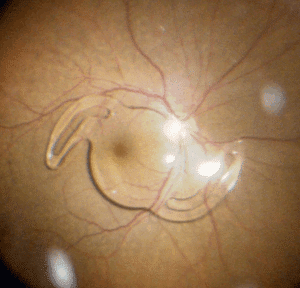
Another surgical option is the replacement of the original lens with one designed to be fixated to the eye wall. The advantage of this maneuver is that a specific lens that is designed for this purpose can be implanted, which leads to more reliable, long-lasting results. The disadvantage is that larger incisions are required in the wall of an eye that is already surgically experienced.
What Are the Risks of Surgery for A Dislocated Intraocular Lens?

Among the complications that can occur with surgery for dislocated lens implant is corneal swelling, bleeding in the eye, retinal detachment, infection, and need for glasses after the procedure. Each of these complications is treatable, and even patients who experience these events tend to have visual outcomes much better than before surgery. It is rare for a lens that is sutured to the eyewall to dislocate again following surgery.

Dislocated Intraocular Lens FAQs
What is a dislocated intraocular lens?
A dislocated intraocular lens (IOL) occurs when the artificial lens implanted during cataract surgery shifts out of its normal centered position inside the eye. When this happens, patients often experience sudden, painless blurry or distorted vision in one eye.
During cataract surgery, the natural cloudy lens is removed and replaced with a clear artificial lens implant. This implant is normally held in place by a thin capsular bag and tiny support fibers called zonules. If the capsular bag weakens or the zonules break, the lens can tilt, move backward, or drop into the back of the eye.
Some dislocations happen during cataract surgery, but many occur years later due to gradual weakening of the support structures. While a dislocated lens is usually not an ER emergency, it can significantly affect vision and may require surgical repair to restore clarity.
If you notice sudden vision changes after cataract surgery, a prompt dilated examination by a retina specialist is the most reliable way to determine whether the lens has shifted and what treatment is appropriate.
Can a dislocated lens be fixed?
Yes. In most cases, surgery can reposition or replace a dislocated intraocular lens and improve visual stability.
The exact approach depends on how far the lens has shifted and the overall health of the eye. If the lens is only slightly tilted, it may be repositioned and secured in place. If it has fallen into the back of the eye or the supporting structures are too weak, the original lens may be removed and replaced with a new lens designed to be fixated more securely.
These procedures are typically performed in an outpatient surgical center under local anesthesia. While the surgery is more complex than standard cataract surgery, outcomes are often good, and many patients experience meaningful improvement in vision compared to leaving the lens out of position.
A careful examination and imaging of the retina are necessary to determine the safest and most effective repair strategy for your specific situation.
What are the symptoms of a dislocated lens?
The most common symptom of a dislocated intraocular lens is sudden, painless blurry vision in one eye. Vision may seem distorted, doubled, or noticeably different compared to the other eye.
Some patients describe:
- Sudden blurring after cataract surgery
- Glare or halos, especially at night
- A shadow or edge in their vision
- A feeling that something is “off” or shifted
- Double vision in one eye
If the lens has significantly moved backward, vision may become very blurry but usually does not go completely black. In some cases, patients may notice changes in their glasses prescription no longer helping.
Because these symptoms can overlap with other eye conditions, a dilated examination is necessary to confirm whether the lens implant has shifted. If you experience sudden vision changes after cataract surgery, prompt evaluation allows your retina specialist to determine whether repair is needed and protect your visual clarity.
Is a dislocated lens an emergency?
A dislocated intraocular lens usually is not an ER emergency, but it should be evaluated promptly by an ophthalmologist, especially if vision changes are sudden. Sudden blurry or distorted vision after cataract surgery should never be ignored, as early treatment can help prevent further complications.
In many cases, a shifted lens implant causes discomfort, glare, double vision, or significant blur, but does not immediately threaten the health of the eye. However, if the lens has fallen into the back of the eye or is causing inflammation, elevated eye pressure, or retinal problems, timely surgical repair may be necessary.
The most important step is a dilated eye examination to determine the position of the lens and assess the overall health of the retina. While most patients can safely be seen within a short timeframe rather than rushing to an emergency room, sudden vision changes should be evaluated as soon as possible to protect your sight. If you have severe eye pain, a sudden curtain of vision loss, or new flashes and floaters, seek urgent evaluation right away.
If you experience rapid vision changes after cataract surgery, contacting a retina specialist for an urgent evaluation is the safest course of action.
What causes intraocular lens dislocation after cataract surgery?
Intraocular lens dislocation usually occurs when the delicate support structures holding the lens implant in place weaken or break over time.
During cataract surgery, the artificial lens is positioned inside a delicate structure called the capsular bag. That bag is held in place by microscopic support fibers known as zonules. If the capsular bag tears during surgery, or if the zonules gradually weaken years later, the lens implant can tilt, shift, or fall backward into the eye.
Late dislocations can happen many years after an otherwise successful cataract procedure. Conditions such as pseudoexfoliation syndrome, prior eye trauma, high nearsightedness, retinal surgery, or multiple previous eye operations increase the risk. In many cases, however, the lens moves simply because the natural support structures weaken with age.
If you notice sudden blurry or distorted vision after cataract surgery and are concerned your lens implant may have moved, a prompt dilated exam is the safest way to determine the cause and discuss appropriate treatment options.
How is a dislocated lens diagnosed?
A dislocated intraocular lens is diagnosed through a comprehensive dilated eye examination. During the exam, the ophthalmologist checks your vision, measures eye pressure, and carefully evaluates the position of the lens implant inside the eye.
After dilation, specialized instruments and imaging allow the retina specialist to determine whether the lens is tilted, partially displaced, or has fallen into the back of the eye. In some cases, additional imaging such as optical coherence tomography (OCT) or ultrasound may be used to assess the retina and surrounding structures.
It is important not only to confirm the lens position but also to evaluate the health of the retina, since a severely displaced lens can sometimes be associated with inflammation, swelling, or retinal complications.
If you experience sudden blurry or distorted vision after cataract surgery, a prompt dilated exam is the safest way to determine whether your lens implant has shifted and whether treatment is necessary.
What are the risks of surgery for a dislocated intraocular lens?
Surgery to repair a dislocated intraocular lens is generally safe and highly effective, but like any eye surgery, it carries some risks. These include infection, bleeding inside the eye, retinal detachment, swelling of the cornea, or changes in glasses prescription after the procedure.
Because this surgery is more complex than standard cataract surgery, it requires careful handling of delicate retinal structures. One of the most serious but rare risks is infection inside the eye, which can threaten vision if not treated promptly. Retinal detachment is another uncommon complication that may require additional treatment.
Some patients may experience temporary inflammation, pressure changes, or retinal swelling after surgery, which is usually treatable with medication and close follow-up.
Despite these potential risks, many patients experience improved and more stable vision after repair compared to leaving the lens out of position. A thorough examination allows your retina specialist to determine whether the benefits of surgery outweigh the risks in your specific case.
Where to Get Dislocated Lens Treatment in Sarasota and Venice
You can receive expert dislocated lens evaluation and treatment at any of our Shane Retina locations throughout Sarasota and Venice, Florida. Each office provides advanced diagnostic testing and surgical treatment options for dislocated intraocular lenses in a calm and efficient clinical setting.
Sarasota - University Parkway Office
Located just west of I-75 on University Parkway in University Health Park.
Our University Parkway location serves patients from Sarasota, Lakewood Ranch, Bradenton, and nearby communities. This office provides comprehensive evaluation and surgical treatment for dislocated intraocular lenses following cataract surgery.
Sarasota - South Tamiami Trail Office
Located on South Tamiami Trail just south of Bee Ridge Road.
Our South Tamiami Trail location serves patients throughout Sarasota, Siesta Key, and surrounding neighborhoods. This office offers full diagnosis and treatment for dislocated lens implants, including surgical repair when needed.
Venice Retina Office
Located in central Venice near Venetia Bay Boulevard.
Our Venice Retina location serves patients in Venice, North Port, Englewood, and nearby communities. This office provides evaluation and treatment for dislocated intraocular lenses for patients in Venice and surrounding communities.
Dislocated Lens Patient Reviews
A difficult job done well.
My wife and I both feel that Dr. Shane and his staff are amazing. I have dealt with eye problems for over 30 years, with multiple doctors and surgeries, and this one of the better experiences I have ever had. I highly recommend Dr. Shane and his staff.
Due to the skill and knowledge of this fine surgeon I have my sight back.
I'm sure there is other good surgeons however, in " my eyes"... there is no better.
Look up these procedures... You will be amazed
Truly a Remarkable man who I owe my sight to
Also Kudos to his staff who is highly trained beyond any other facility I have had to deal with.
Thank You ..
Kurt
Dislocated Lens Surgery In Sarasota And Manatee County
Shane Retina, is specialized in managing dislocated lenses. If you experience the symptoms mentioned above, consider having a dilated eye examination with an ophthalmologist. This exam may involve photographs or other specialized imaging tests of the retina. There are effective surgical treatments for a dislocated intraocular lens, so do not delay your evaluation.