
Intravitreal Eye Injections in Sarasota and Bradenton

These quick, gentle treatments can help preserve and even improve your vision.

Intravitreal injections deliver medication directly where it’s needed to treat conditions like macular degeneration, diabetic retinopathy, and retinal vein occlusion. Most patients find the procedure fast and comfortable with numbing drops.

If you receive retina care in Sarasota, Bradenton, Lakewood Ranch, or Venice, we offer consultations to determine the right injection plan for you.

Shane Retina > Intravitreal Eye Injections

At a Glance: Intravitreal Eye Injections

An intravitreal injection places medicine directly into the gel inside the eye, where it can reach the retina. Eye injections are the main treatment for several of the most common causes of vision loss in older adults.

  • What they treat: Wet macular degeneration, diabetic macular edema and diabetic retinopathy, retinal vein occlusion, and geographic atrophy from advanced dry macular degeneration.
  • What it feels like: The eye is numbed first. Most patients feel brief pressure with little or no pain, and the injection itself takes only a few seconds.
  • How well they work: For wet macular degeneration, anti-VEGF injections at least stabilize vision in about 9 out of 10 patients and improve it in about 1 in 3.
  • How often: Many patients start with monthly injections. Once the eye is stable, the time between injections is often stretched out. Some patients with wet macular degeneration or diabetic macular edema can go four to five months between injections on newer medicines.
  • Safety: Serious problems are rare. Call us right away if, in the days after an injection, your eye pain is severe or getting worse, the eye becomes more red, it turns sensitive to light, or your vision drops.

Shane Retina gives eye injections at two Sarasota offices and in Venice, for patients from Bradenton, Lakewood Ranch, North Port, Englewood, and nearby communities.

Table of Contents
    Add a header to begin generating the table of contents
    Scroll to Top

    Medically reviewed by Thomas Shane, M.D., Retina Specialist – Last updated October 2, 2026

    Eye Injections and Preventing AMD-related Blindness

    An eye injection is done using an ultra-thin needle to deliver medication right to the back of the eye. Eye injections aren’t painful, however, you might feel a little pressure.

    At the rear of the eye and the center of the retina lies the macula—the part of the eye that does the high-quality seeing. Most problems of the retina, including age-related macular degeneration (AMD), originate here. Without intravitreal injections, more than 1 million people in the US would lose their central vision—this is the number of people currently living with wet AMD.

    What Happens During An Eye Injection?

    A retinal ophthalmologist is a specialist qualified to do eye injections. While preparing for the procedure takes a couple of minutes, the actual injection lasts only seconds.

    You will lie face up in a comfortable position in a reclining chair. The retina specialist will apply drops in your eyes for numbing. They’ll clean your eyes and eyelids using an antiseptic to reduce the risk of bacterial contamination during the procedure.

    After the cleaning, the eye doctor applies an additional anesthetic to your eye using a cotton tip. These numbing eye drops reduce sensation on the eyeball to nearly zero.

    The retina specialist then uses a small clip called a speculum to keep your eyelids open during the technique. The specialist will instruct you to look away so he/she can deliver the shot through the white part of your eye.

    After the shot, your eye specialist removes the speculum and cleans your eye once again to minimize discomfort. He will further check the eye to ensure there are no complications.

    What Are Intravitreal Injections Used For?
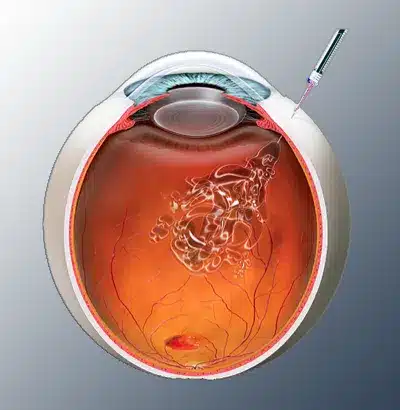
    Image of Intravitreal Eye InjectionEye injections have dependable results in the treatment of many retinal conditions. These include age-related macular degeneration, retinal vein occlusion, and diabetic retinopathy—with eye injections you stand a chance of stopping the progression of these diseases and even regaining vision.

    The most common category of medication delivered through the injection is called anti-VEGF. It works for almost all the conditions that cause swelling or bleeding in the retina. The medication stops the growth of abnormal blood vessels, bleeding, and fluid leakage under the retina. A new class of injectable drugs has gained FDA approval for geographic atrophy, the advanced form of dry macular degeneration. These medications block a type of immune response in the eye, slowing the formation of blind spots in the central vision. Depending on your eye condition, eye injections might also contain steroid, antibiotic, antifungal, or antiviral drugs. 

    Conditions We Treat With Eye Injections

    • Wet macular degeneration, where abnormal blood vessels leak fluid and blood under the macula
    • Diabetic retinopathy and diabetic macular edema, swelling of the central retina from leaky blood vessels
    • Retinal vein occlusion, a blocked vein that causes swelling and bleeding in the retina
    • Geographic atrophy, the advanced form of dry macular degeneration, treated with Syfovre and Izervay, which slow the growth of damaged areas but do not restore lost vision
    • Less common conditions, such as inflammation inside the eye (uveitis) and certain eye infections
    Illustration of an eye with wet macular degeneration showing a dark red area of leaking blood at the macula, with a close-up of the retina labeled blind spot in center of field of vision.
    Wet macular degeneration, with bleeding at the macula that can cause a blind spot in the center of vision.
    Call our retina specialists at (941) 351-1200 if you notice new blur or distortion in your central vision, or if your eye doctor has recommended eye injections. We will explain your options and help you get started.

    What to Expect Before and After Your Injection

    Before the Injection

    Most injection visits begin with a vision check and an OCT scan, a quick test that uses light to show the layers of the macula in cross-section. The scan shows whether fluid or swelling has come back. Your retina specialist uses it to decide whether you need an injection that day and when you should return.

    Some visits also include dilating drops or other imaging. One example is fluorescein angiography, a series of photographs taken as a dye injected into an arm vein flows through the blood vessels of the retina.

    A doctor in a white coat holds a tablet showing a color photograph of the retina and explains it to an older woman.
    A doctor shows a patient a color photograph of the retina.

    After the Injection

    The eye may feel scratchy or irritated for the rest of the day, partly from the antiseptic used to clean it. A small red spot on the white of the eye is common and usually fades within about a week. You may also notice a few small floaters or tiny bubbles in your vision for a day or two.

    Most people go back to light daily activities right after treatment. For the first day, try not to rub the eye, and avoid swimming, hot tubs, heavy lifting, and strenuous exercise. Use any drops exactly as your retina specialist directs.

    If You Feel Nervous About Your First Injection

    The idea of a needle near the eye can sound frightening, and many first-time patients feel uneasy. The eye is numbed first, and more numbing medicine is added before the injection. A small clip holds the eyelids open, so you do not have to worry about blinking. You look away during the injection, and the injection itself is over in seconds.

    Many patients find the second visit far easier than the first, once they know what to expect. If you are anxious, tell our team, and we will explain each step as we go.

    How Frequently Should You Have Eye Injections?

    Once a retina specialist establishes that you have a condition that would benefit from eye injections, they’ll design a treatment schedule for you.

    The frequency of the eye injections depends on the condition, the severity of retinal swelling, and the potency of the medication used. Some can be repeated every 3 months while the most common ones are usually given every 4-6 weeks at first to maximize the efficiency of the therapy.

    In some cases, patients have recovered significant vision as the bleeding stops and retinal swelling improves. Patients with diabetes may need more intermittent shots than other groups of people. The ophthalmologist carefully assesses your condition before deciding that an eye injection is the best approach.

    Can Eye Injections Cure Age-Related Macular Degeneration (AMD)?
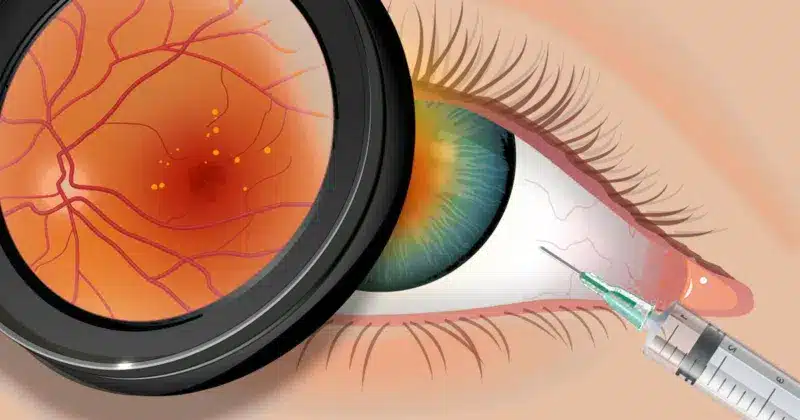
    Intravenous Eye Injections | Clipart of injection in the eyeThere are two types of AMD. One is dry AMD, which benefits from a new class of drugs called complement inhibitors.  The first of these drugs, called Syfovre, gained FDA approval in 2023.  Injected into the eye every 1-2 months, Syfovre slows down the development of blind spots in the central vision by blocking the immune system from damaging retinal cells.

    The other type is wet AMD, for which eye injections can also help stop the condition and save vision. Wet AMD is treatable because of its nature—it causes abnormal blood vessels to grow under the retina. They start to leak fluid and blood into the macula. Anti-VEGF medication can stop this.

    VEGF is short for vascular endothelial growth factor—this is a protein signal that helps the body to grow new blood vessels when you need them. But when you have AMD, the new blood vessels often tend to be weak and spring up in places that interfere with the eye’s visual acuity. Anti-VEGF medication is delivered via injection to the back of the eye to stop the growth of these troublesome and abnormal blood vessels. As a result, there is less swelling and inflammatory damage to the macula. 

    How Do Eye Injections Work?

    If you are getting the injection for Dry AMD, the shot will contain a complement inhibitor. Currently, two FDA-approved medications of this kind are available: pegcetacoplan (Syfovre) and avacincaptad pegol (Izervay).

    Eye injections take some getting used to. It may be scary at first, but the therapy is fast and void of pain. The ophthalmologist does it with great care to keep it minimally invasive.

    If you are getting the injection for wet AMD, the shot will contain one of these anti-VEGF medications:

    • Ranibizumab (Lucentis)
    • Brolucizumab (Beovu)
    • Bevacizumab (Avastin)
    • Aflibercept (Eylea)
    • Faricimab (Vabysmo)

    These meds are all useful in stopping the growth of abnormal blood vessels in the eye. However, they have varying degrees of potency and side effects. The retinal ophthalmologist will consider your medical history before choosing the best option for you.

    Newer and Longer-Acting Treatment Options

    Retina care has changed quickly in the past few years. Some newer treatments aim to keep the eye stable with fewer injections, and others add more choices of medicine.

    • High-dose aflibercept (Eylea HD): After the first three monthly doses, some patients with wet macular degeneration or diabetic macular edema can go two to four months between injections. After a year of good response, some can go about five months.
    • Faricimab (Vabysmo): Blocks two signals that drive leaking blood vessels. After four monthly starting doses, some patients with wet macular degeneration can be treated as little as once every four months.
    • Biosimilars: FDA-approved versions of ranibizumab and aflibercept that work like the original medicines. Some insurance plans have rules about which version you receive.
    • The Susvimo ocular implant: A tiny, refillable reservoir placed in the eye during a one-time outpatient surgery. It releases ranibizumab continuously and is refilled about every six months for wet macular degeneration and diabetic macular edema. It is meant for patients who have already responded to at least two anti-VEGF injections. In studies it had up to three times the rate of a serious eye infection (endophthalmitis) seen with monthly injections.
    • Steroid medicines: Steroid injections and slow-release implants, such as Ozurdex, Iluvien, and Yutiq, can help some patients with diabetic macular edema, retinal vein occlusion, or uveitis that is not caused by an infection. Steroids can raise eye pressure and speed up cataract formation, so they are used selectively.

    Your retina specialist will recommend a medicine based on your diagnosis, your scans, your insurance, and how your eye has responded so far.

    When to Call a Retina Specialist:

    Serious problems after an eye injection are rare. The most important ones to catch early are an infection inside the eye and a retinal detachment. Both can show up in the days after an injection and need treatment right away.

    Call us right away if, after an injection, you notice:

    A little scratchiness and a few floaters in the first day or two are normal, and a small red spot can take about a week to fade. Symptoms that are severe or keep getting worse need a call right away. Phone (941) 351-1200 and tell us you recently had an injection. If you cannot reach us, go to the nearest emergency room.

    Eye injections have dependable results in the treatment of many retinal conditions.

    – Dr. Thomas Shane,
    Eye Injection Specialist and founder of Shane Retina

    Intravitreal Eye Injection FAQs

    Click on a question below to view the answer.

    Eye injections are used to deliver medication directly into the back of the eye to treat retinal diseases. They are most commonly used to manage conditions such as wet macular degeneration, diabetic retinopathy, diabetic macular edema, and retinal vein occlusion.

    These injections help reduce swelling, stop abnormal blood vessel growth, and prevent further vision loss. In many cases, they can stabilize or even improve vision when given consistently.

    By placing medication directly where it is needed, intravitreal injections provide a highly targeted and effective form of treatment.

    An intravitreal injection is a procedure in which medication is injected directly into the vitreous cavity, the gel-filled space in the center of the eye. This allows the medication to reach the retina and macula at therapeutic levels.

    The word “intravitreal” simply means “inside the vitreous.” By delivering medication directly into the eye, retina specialists can treat conditions such as wet macular degeneration, diabetic retinopathy, retinal vein occlusion, and geographic atrophy more effectively than with pills or eye drops.

    The procedure is performed in the office under sterile conditions. The eye is numbed with anesthetic drops, cleaned with antiseptic, and the injection itself takes only a few seconds. Most patients feel pressure rather than pain.

    Intravitreal injections are a major advance in modern retina care and have helped prevent vision loss in millions of patients.

    Robert Johnson (fictitious name), a Sarasota-based senior, avoided losing his eyesight via early detection and treatment of AMD. During a dilated eye exam, we noticed an increased cluster of drusen in the back of his right eye. We conducted imaging tests that revealed significant swelling in the retina area and confirmed a budding form of wet AMD. Six shots of anti-VEGF within the same year stopped it in its tracks.

    Mr. Johnson’s case is just one among the many successful treatments that the ophthalmologists at Shane Retina have had with eye injections. Research continues to search for a way to give injections less frequently or replace them with a topical drop.

    A good number of patients treated with anti-VEGF have regained normal macular anatomy after consistent treatment. Vision improves as well. However, in patients who have already lost central vision, the medication may not bring back all the vision that was lost.

    Most patients are surprised to learn that eye injections are not painful. The eye is thoroughly numbed with anesthetic drops before the injection, and many patients feel only mild pressure or slight awareness of the procedure.

    The injection itself takes only a few seconds. You may notice brief pressure during the shot, but sharp pain is uncommon. Afterward, the eye can feel slightly scratchy or irritated for the rest of the day, similar to having a grain of sand in the eye. This sensation typically resolves within 24 hours.

    Because the procedure is quick and performed under sterile conditions, most patients find it much easier than they expected. Many who were anxious before their first injection report that the experience is far less uncomfortable than anticipated.

    Yes, intravitreal eye injections are considered very safe when performed by a trained retina specialist under sterile conditions. They have been used for over two decades and have prevented vision loss in millions of patients.

    The procedure itself is quick and carefully controlled. The eye is cleaned with antiseptic and numbed before the injection to minimize discomfort and reduce the risk of infection.

    As with any medical procedure, there are risks, but serious complications are rare. The most serious risk is infection inside the eye, known as endophthalmitis, which occurs in approximately 1 in several thousand injections. Other uncommon risks include retinal detachment or significant inflammation.

    More commonly, patients may experience mild redness, irritation, temporary floaters, or slight blurriness for a day or two.

    Overall, the risk of not treating conditions like wet macular degeneration is far greater than the risk associated with properly administered eye injections.

    The number of eye injections you need depends on your specific condition, how severe it is, and how your eye responds to treatment.

    Many patients start with a series of monthly injections to control swelling or abnormal blood vessel growth. Once the condition is stable, treatments are often spaced out over time using a “treat-and-extend” approach, where injections are given less frequently while still keeping the disease under control.

    Some patients may need ongoing injections every few weeks to months, while others can go longer between treatments. Because retinal conditions are chronic, many people require long-term monitoring and periodic injections to maintain their vision.

    Your retina specialist will adjust your treatment plan based on imaging and how your vision responds over time.

    Most side effects of eye injections are mild and temporary. The most common reactions occur on the surface of the eye and typically resolve within a day or two.

    Common side effects include:

    • Redness on the white part of the eye
    • Mild irritation or scratchy sensation
    • Temporary blurring of vision
    • Small floaters immediately after the injection
    • A small surface blood spot where the injection was placed

    These symptoms usually improve quickly and do not affect long-term vision.

    Rare but serious complications can occur. These include infection inside the eye, known as endophthalmitis, significant inflammation, retinal detachment, or increased eye pressure. Severe pain, worsening vision, or light sensitivity after an injection should be reported immediately.

    Although complications are uncommon, retina specialists use sterile technique and careful monitoring to minimize risk. For most patients, the benefits of preventing vision loss far outweigh the potential side effects.

    Eye injections start working within days to weeks, but noticeable vision improvement may take several weeks, depending on the condition being treated.

    For wet macular degeneration, diabetic macular edema, or retinal vein occlusion, anti-VEGF injections begin reducing retinal swelling shortly after administration. Some patients notice clearer vision within a week or two, while others may require multiple injections before meaningful improvement occurs.

    In many cases, the first goal is stabilization rather than immediate improvement. Swelling decreases gradually, and vision may improve over the course of several treatments.

    Your retina specialist monitors progress with imaging such as OCT scans to measure changes in retinal fluid and determine how well the medication is working. Treatment intervals may be adjusted based on response.

    Whether you can drive after an eye injection depends on how your vision feels immediately afterward. Most patients are comfortable driving after an injection. We welcome you to bring a driver if you have any concern.

    If your eyes were dilated before the injection, your vision may remain blurry or light-sensitive for several hours. In addition, it is common to experience temporary floaters or mild irritation after the procedure.

    For safety, many retina specialists recommend arranging a driver for your first injection so you can see how your eyes respond.

    Your retina specialist can guide you based on your specific situation and visual stability.

    You do not need strict bed rest after an eye injection, but it is reasonable to take it easy for the rest of the day.

    Most patients can resume normal daily activities shortly after the procedure. However, your eye may feel mildly irritated or scratchy for several hours. Avoid rubbing your eye, and follow any post-injection instructions provided by your retina specialist.

    It is generally safe to:

    • Read or watch television
    • Walk around normally
    • Perform light household activities

    For the first 24 hours, you may want to avoid:

    • Heavy lifting
    • Strenuous exercise
    • Swimming or hot tubs
    • Touching or rubbing the eye

    If you experience severe pain, worsening vision, or increased light sensitivity, contact your retina specialist immediately.

    Light activity is usually safe after an eye injection, but strenuous exercise should be avoided for about 24 hours.

    You can typically walk, perform normal daily activities, and move around as usual the same day. However, it is best to avoid:

    • Heavy lifting
    • High-intensity workouts
    • Straining or bending repeatedly
    • Swimming or hot tubs

    Your eye may feel mildly irritated or sensitive for the rest of the day, and avoiding strenuous activity reduces the risk of irritation or increased pressure.

    Most patients can return to full exercise the following day unless your retina specialist advises otherwise.

    Eye injections treat macular degeneration, but they do not cure it. If you stop receiving injections for wet macular degeneration, abnormal blood vessels can begin growing and leaking again.

    When this happens, fluid and bleeding can return under the retina. Over weeks to months, this can lead to permanent central vision loss. In many cases, the vision that is lost after stopping treatment cannot be fully recovered, even if injections are restarted later.

    That is why consistent treatment is important. Retina specialists often use a treat-and-extend approach to safely lengthen the interval between injections while keeping the disease under control. Stopping treatment entirely without medical guidance increases the risk of irreversible damage.

    If scheduling, transportation, or discomfort is making treatment difficult, speak with your retina specialist. Treatment intervals can often be adjusted while still maintaining disease control.

    Almost all medical insurances cover the diagnosis and treatment of eye conditions that require eye injections, but you are still subject to their copays, deductibles, and coinsurance.  Some insurances will have requirements for which drug is injected into your eye.  There are funds sponsored by the drug manufacturers that may help defray some of the cost of the medication.

    Reviews of Our Eye Injection Services

    Eye injections are rarely anyone’s favorite appointment, and some of the patients below say so. They describe a kind, caring team and a gentle injection specialist who answers their questions. Some say the treatment is helping them.

    These reviews are a small sample of what patients have said about their eye injection care at Shane Retina.

    ACg8ocJMALcayMhhH53rCTTmYdeq8JFe8TpX PdhwrRmUymaKrjpEQ=s56 c rp mo br100
    Lena Rink
    6 days ago
    Dr Shane is wonderful as well as all of his staff Including Ayah for injections.
    ALV UjWYbbtvfnQR v3u6Lgvaz0D dRD2xTytS1Pg6h2CSp0DhpOG60=s56 c rp mo br100
    Tina Fox
    2 months ago
    Everyone is very nice there. Getting a shot in your eye is not easy but my Dr. is great. She has helped me a lot.
    ALV UjVhqhlmtYkdvwQ9eg4URlorI9rsOm7JspcySzUWkJpj1n5CcirI=s56 c rp mo ba12 br100
    Kim Martin
    3 months ago
    It didn't take long for Ayah to get me in for my eye injection. An was the tech and she did a great job of getting me ready for Ayah.
    ALV UjUTdBk7 ldpRdFikpZ2qeKTtA bFkTwxmHHR39Pip2YkgjFXQ=s56 c rp mo br100
    Vicki Stelzer
    3 months ago
    Dr. Shane is a very skilled professional. My husband requires regular eye injections. Ayah, the injection specialist, does an excellent job.
    ALV UjV2tPy8Vx XCBhuuYuZWVlrQLHdKHdD5F03GHZdBLfTpH0OVSKvw=s56 c rp mo ba12 br100
    Michael McEvoy
    4 months ago
    Ayah always does a professional job when I receive my eye injections
    ALV UjXEYdvHe6XctAebpyV7hSCJmuoBAVEUQXjX9GWsTGlVgTraQXCM=s56 c rp mo ba12 br100
    Judy Newlin
    4 months ago
    I was ecstatic. I had my first injection in my right eye by Dr Ayah Etyem 4 weeks before and they took photographs of my eye again. Already the injection is working so well.
    ALV UjVhqhlmtYkdvwQ9eg4URlorI9rsOm7JspcySzUWkJpj1n5CcirI=s56 c rp mo ba12 br100
    Kim Martin
    4 months ago
    Ajah is always there to answer any questions about my eye injections AND she is very gentle in doing this too. I personally wouldn't want anyone else to do by eye injections. I've ALWAYS had a great experience with my eye injections! I trust Dr. Shane and his staff completely with my eye health!
    ACg8ocLgzdPo8kNNZv3qeoFxZ2I DQtBs umhfTyzNTTZSVSBGcBbg=s56 c rp mo br100
    Rosemary Erbeck
    5 months ago
    Always compassionate and friendly staff for a not so fun procedure (Vabysmo injection). Ayya is always informative and very positive in her approach. She does all she can to make the injection as comfortable as possible.

    Your Shane Retina Care Team

    Eye injections at Shane Retina are administered by our team of fellowship-trained retina specialists and our dedicated eye injection specialist, who focus on making each visit safe, comfortable, and efficient.

    Thomas Shane, M.D., retina specialist and founder of Shane Retina in Sarasota, Florida

    Thomas Shane, M.D.

    Founder of Shane Retina and a Bascom Palmer-trained vitreoretinal surgeon. Known for thorough exams, clear explanations, and an unhurried approach that has built lasting relationships with patients over many years.
    Anita Shane, M.D., retina specialist and founder of Venice Retina in Venice, Florida

    Anita Shane, M.D.

    Founder of Venice Retina and a Bascom Palmer-trained vitreoretinal surgeon. Patients describe her as kind, calm, and reassuring, with a gift for explaining complex retinal conditions in language anyone can understand.
    Konica Singla, M.D., retina and ocular oncology specialist at Shane Retina in Sarasota, Florida

    Konica Singla, M.D.

    Dual fellowship-trained in ocular oncology at Wills Eye and medical retina at Bascom Palmer. Patients describe her exams as thorough, her explanations as calm and clear, and her approach as one that puts even nervous patients at ease.
    Maria Castaños, M.D., medical retina specialist at Shane Retina in Sarasota, Florida

    Maria Castaños, M.D.

    Medical retina specialist fellowship-trained at New York Eye and Ear Infirmary of Mount Sinai. Known for detailed evaluations, direct explanations of treatment options, and an evidence-based approach informed by her published research. Fluent in Spanish.
    Gabriel Dib, FNP-C, retinal nurse practitioner at Shane Retina in Sarasota and Venice, Florida

    Gabriel Dib, FNP-C

    Originally trained as an ophthalmologist in Venezuela, where he practiced vitreoretinal surgery for 11 years before relocating to the United States. Patients describe him as thorough, gentle, and exceptionally generous with his time. Fluent in Spanish.
    Ayah Etyem, PA-C, eye injection specialist at Shane Retina in Sarasota, Florida

    Ayah Etyem, PA-C

    Eye injection specialist who began her career in ophthalmology working alongside Dr. Thomas Shane in Sarasota. Patients describe her as calm, kind, and reassuring, with a gift for making injection visits comfortable and as close to painless as possible.
    Kayla Fischer, PA-C, eye injection and Valeda light therapy provider at Shane Retina in Venice and Sarasota, Florida

    Kayla Fischer, PA-C

    Physician assistant focused on eye injection care and Valeda light therapy, seeing patients in Venice and South Sarasota. She first worked in retina care as an ophthalmic technician in Tallahassee and gave intravitreal injections during her vitreoretinal rotation.

    Get Expert Eye Injection Treatment in Sarasota & Venice

    If you’ve been told you need eye injections, or you’re noticing changes in your vision, our retina specialists are here to help. We use advanced intravitreal injection therapies to treat macular degeneration, diabetic eye disease, and retinal vein occlusion with a focus on comfort, safety, and long-term results.

    Every treatment plan is tailored to your condition, your response to therapy, and your goals for vision. Our team will guide you through each step so you feel confident, informed, and supported throughout your care. You’re in good hands at Shane Retina.